Diễn Đàn » English Club

Science

120 trả lời, 20.095 lượt xem — Trang 1 / 5
Scientists Say Everyone Can Read Minds

Special to LiveScience
LiveScience.com
Wed Apr 27,10:24 AM ET

Empathy allows us to feel the emotions of others, to identify and understand their feelings and motives and see things from their perspective. How we generate empathy remains a subject of intense debate in cognitive science.

Mirror neurons

In 1996, three neuroscientists were probing the brain of a macaque monkey when they stumbled across a curious cluster of cells in the premotor cortex, an area of the brain responsible for planning movements. The cluster of cells fired not only when the monkey performed an action, but likewise when the monkey saw the same action performed by someone else. The cells responded the same way whether the monkey reached out to grasp a peanut, or merely watched in envy as another monkey or a human did.

Because the cells reflected the actions that the monkey observed in others, the neuroscientists named them "mirror neurons."

Later experiments confirmed the existence of mirror neurons in humans and revealed another surprise. In addition to mirroring actions, the cells reflected sensations and emotions.

"Mirror neurons suggest that we pretend to be in another person's mental shoes," says Marco Iacoboni, a neuroscientist at the University of California, Los Angeles School of Medicine. "In fact, with mirror neurons we do not have to pretend, we practically are in another person's mind."

Since their discovery, mirror neurons have been implicated in a broad range of phenomena, including certain mental disorders. Mirror neurons may help cognitive scientists explain how children develop a theory of mind (ToM), which is a child's understanding that others have minds similar to their own. Doing so may help shed light on autism, in which this type of understanding is often missing.

Theory theory

Over the years, cognitive scientists have come up with a number of theories to explain how ToM develops. The "theory theory" and "simulation theory" are currently two of the most popular.

Theory theory describes children as budding social scientists. The idea is that children collect evidence -- in the form of gestures and expressions -- and use their everyday understanding of people to develop theories that explain and predict the mental state of people they come in contact with.

Vittorio Gallese, a neuroscientist at the University of Parma in Italy and one of original discovers of mirror neurons, has another name for this theory: he calls it the "Vulcan Approach," in honor of the Star Trek protagonist Spock, who belonged to an alien race called the Vulcans who suppressed their emotions in favor of logic. Spock was often unable to understand the emotions that underlie human behavior.

Gallese himself prefers simulation theory over this Vulcan approach.

Natural mind readers

Simulation theory states that we are natural mind readers. We place ourselves in another person's "mental shoes," and use our own mind as a model for theirs.

Gallese contends that when we interact with someone, we do more than just observe the other person's behavior. He believes we create internal representations of their actions, sensations and emotions within ourselves, as if we are the ones that are moving, sensing and feeling.

Many scientists believe that mirror neurons embody the predictions of simulation theory. "We share with others not only the way they normally act or subjectively experience emotions and sensations, but also the neural circuits enabling those same actions, emotions and sensations: the mirror neuron systems," Gallese told LiveScience.

Gallese points out, however, that the two theories are not mutually exclusive. If the mirror neuron system is defective or damaged, and our ability to empathize is lost, the observe-and-guess method of theory theory may be the only option left. Some scientists suspect this is what happens in autistic people, whose mental disorder prevents them from understanding the intentions and motives of others.

Tests underway

The idea is that the mirror neuron systems of autistic individuals are somehow impaired or deficient, and that the resulting "mind-blindness" prevents them from simulating the experiences of others. For autistic individuals, experience is more observed than lived, and the emotional undercurrents that govern so much of our human behavior are inaccessible. They guess the mental states of others through explicit theorizing, but the end result is a list -- mechanical and impersonal -- of actions, gestures and expressions void of motive, intent, or emotion.

Several labs are now testing the hypothesis that autistic individuals have a mirror neuron deficit and cannot simulate the mental states of others.

One recent experiment by Hugo Theoret and colleagues at the University of Montreal showed that mirror neurons normally active during the observation of hand movements in non-autistic individuals are silent in those who have autism.

"You either simulate with mirror neurons, or the mental states of others are completely precluded to you," said Iacoboni.

Related Stories

Brain Breakthrough: Scientists Know What You'll Do
Brain Power: Mind Control of External Devices
Only Using Part of Your Brain? Think Again
Study: Your Brain Works Like the Internet
Visit LiveScience.com for more daily news, views and scientific inquiry with an original, provocative point of view. LiveScience reports amazing, real world breakthroughs, made simple and stimulating for people on the go. Check out our collection of Image Galleries, Interactive Features, Trivia and more.

http://story.news.yahoo.com/news?tmpl=story&cid=96&ncid=96&e=2&u=/space/20050427/sc_space/scientistssayeveryonecanreadminds
Đăng nhập để trả lời
0
Iowa Scientist Helps Interpret Rover Data

By TODD DVORAK, Associated Press Writer
Sat May 14, 7:26 PM ET

IOWA CITY, Iowa - To the teams of researchers analyzing photographs and other data beamed back to Earth by the Mars rovers, Geb Thomas is equal parts detective, optometrist and quality control manager.

Thomas, an engineering professor at the University of Iowa, helps NASA geologists interpret what they see — helping them to avoid confusing pebbles with boulders as they scan the dusty, Martian landscape with a pair of rolling robots.

"Driving a robot is like walking by, only looking through a paper towel tube. It's not easy," said Thomas, who was awarded a three-year $835,000 grant to continue his piece of the Mars exploration.

Just as challenging, Thomas says, is training geologists to make observations with photography instead of their vision and field training.

He helps them draw reasonable conclusions from rover images that appear within a limited field of vision and uncertain depth perception.

His work to narrow the divide between perception and reality will take him this fall to Chile's Atacama desert, an arid, lifeless environment about as close as any spot on Earth gets to Mars, Thomas and others say.

"There is definitely a gap between what a geologist can do — scientifically — through a robot," Thomas said. "We don't really understand what other factors are creating a difference between what a geologist can do and see in the field and what a robot provides ... and that's the game we're trying to play."

To shrink that information gap, Thomas began working with the NASA geologists assigned to interpret the images and data returned by the twin rovers — Spirit and Opportunity — in 2003.

In a series of tests in an Arizona desert, Thomas trained geologists on how camera distortion and resolution can fool even the best eyes.

As robots performed maneuvered across the desert floor, Thomas recorded the observations scientists made about the rocks, geologic features and other information transmitted by the robots.

Then next phase, which involved taking geologists to the field to compare first hand their observations with reality, yielded some surprising results, Thomas said. For example, the teams misinterpreted the depth of a stream bed, mistook a mound in the distance for a mountain and found rocks to be bigger, rounder and flatter than they actually were.

Yet the geologists hit the mark most of the time, with errors in judgment or a hypothesis accounting for just 5 percent overall, Thomas said.

"Looking through the eyes of a robot are so difficult," said David Wettergreen, the project manager and assistant professor at Carnegie Mellon University.

"The geologists know how to survey and assess at a field sight, and make quick assumptions about formations and events. What the research is showing that's so interesting is what is it about using a robot, rather than yourself to explore a site, that makes things so much more difficult and complex."

In Chile, Thomas and others will study, among other things, spatial distribution and composition of minerals, rocks and soils and obtain images of bacteria to help prepare for future robotic investigations of Mars' surface.

In January, NASA celebrated the one-year anniversary of the landing of the twin rovers on Mars. The rovers were expected to last just three months, but are still roaming the planet, with Spirit having logged 2.47 miles to date and Opportunity 1.27 million miles.

So far, the six-wheel rovers have transmitted to Earth 62,000 images and 86 gigabits of scientific data, according to NASA officials.

http://news.yahoo.com/s/ap/mars_rover
Đăng nhập để trả lời
0
<Bài viết đã được chỉnh sửa lúc 2005-08-02 01:18:24HongYen>
.

Shuttle Discovery on launch pad


NASA: Shuttle Launch One Week Away


By VOA News
15 July 2005

The U.S. space agency says it will not try again to launch the shuttle Discovery until late next week, as engineers struggle to fix an equipment malfunction.

A NASA spokesman says officials are due to meet Friday to discuss their plans and ongoing repair work.

Engineers say they have yet to solve the problem behind a faulty fuel sensor that forced a delay in Wednesday's planned launch.

NASA hopes to launch the Discovery before the end of July, otherwise the flight will be pushed back until September.

The seven-member crew of the Discovery will conduct the first shuttle launch since the Columbia disaster in 2003.

Some information for this report provided by AFP, AP and Reuters.

http://www.voanews.com/english/NASA-Shuttle-Launch-One-Week-Away.cfm
Đăng nhập để trả lời
0
* US Landfills Convert Trash into Clean Energy Source
* Aquarius: An Undersea Laboratory Where Scientist Can Live for Weeks at a Time
* NASA Considers Emergency Shuttle Spacewalk to Fix Heat Insulation
* Future of US Space Shuttle Program Once Again in Doubt
* NASA Considers Space Walk to Fix Discovery Heat Insulation
* NASA Says Damage to Shuttle Discovery Surface Insignificant
* Shuttle Astronauts Finish First Spacewalk
* Discovery Astronauts Make First of Three Spacewalks

http://www.voanews.com/english/Science/index.cfm
Đăng nhập để trả lời
0
<Bài viết đã được chỉnh sửa lúc 2005-08-02 01:34:19HongYen>
Astronauts Work to Fix Station's Gyroscope

AP - Mon Aug 1,10:35 AM ET

SPACE CENTER, Houston - Two of Discovery's astronauts floated outside their spacecraft Monday with one key task: to replace a failed washing machine-sized spinning wheel, which along with three other gyroscopes, helps to steer the international space station. Astronauts Stephen Robinson and Soichi Noguchi planned to spend 6 1/2-hours exchanging the broken down 660-pound gyroscope, which failed in 2002, with a new one. "Is it day or night out there?" Robinson asked minutes before the two opened the orbiting shuttle's airlock.

http://news.yahoo.com/fc/science/space_shuttle

📎 r3386959291
Đăng nhập để trả lời
0
Japanese astronaut Soichi Noguchi, riding on the robot arm of the International Space Station, lowers the 620-pound failed gyroscope from the station into Discovery's cargo bay in this view from television Monday, Aug. 1, 2005. The gyroscope is used along with three other gyroscopes to maintain and adjust the station's attitude, or orientation, relative to the Earth. (AP Photo/NASA TV) Email Photo Print Photo

📎 capt
Đăng nhập để trả lời
0

LIVE Video
Watch NASA TV from the Shuttle Mission
NASA TV Schedule
All times Eastern time (ET)
Friday, August 5
10:09 p.m. Discovery crew wake up (sleep cycle began at 2:09 p.m.)

Saturday, August 6
3:22 a.m. Discovery/ISS undocking
5:05 a.m. Final separation from ISS
9:30 a.m. Mission status briefing
1:00 p.m. Flight day 11 highlights (replayed during crew sleep)

Sunday, August 7
6:09 a.m. Discovery crew de-orbit review
7:30 a.m. Mission status briefing
1:00 p.m. Flight day 12 highlights (replayed during crew sleep)
11:34 p.m. De-orbit preparations begin

Monday, August 8
3:43 a.m. De-orbit burn
4:46 a.m. Kennedy Space Center landing
6:00 a.m. Post-landing news conference (time subject to change)
TBD Crew news conference


Detailed NASA TV Schedule at NASA
Đăng nhập để trả lời
0
NASA Boss in Hot Seat for Others' Choices By MARCIA DUNN, AP Aerospace Writer
Sat Aug 6,12:26 PM ET


SPACE CENTER, Houston - The man ultimately responsible for bringing Discovery's astronauts safely home doesn't talk about his feelings. NASA chief Michael Griffin favors reason over emotion. He chooses straight talk over spin. He sees himself as the rational "Spock" of Star Trek.

ADVERTISEMENT

A 55-year-old rocket scientist with a pile of academic degrees, Griffin was put in charge of the space agency after almost all the crucial decisions had been made about what to fix and what to ignore on the shuttle following the Columbia disaster.

Yet when mission managers reached the horrifying conclusion soon after liftoff that Discovery suffered from the same problem that brought down Columbia 2 1/2 years ago — the loss of a big piece of fuel-tank insulating foam — Griffin took full responsibility.

He said he's seen his share of mistakes in a 35-year scientific career. Losing a large chunk of foam from a rocket fuel tank is just one more.

The drama isn't over yet.

On Monday, weather permitting, Discovery and its crew of seven will plunge through the atmosphere and aim for a Florida touchdown following the first-ever orbital repairs to a shuttle's thermal shield, performed in a hugely successful spacewalk.

"I believe that this shuttle is in as good of shape as any that we have ever had to execute what is always a very difficult maneuver, a re-entry from space," Griffin said Friday.

Griffin admits being disappointed by the alarming foam loss during Discovery's launch, the first since Columbia's 2003 doomed flight, but not mortified like one of his shuttle deputies, Wayne Hale.

Rarely lacking in pithy eloquence, Hale apologized in a message sent up to the astronauts after liftoff, saying he was mortified about the flyaway foam. He later told reporters that the Columbia tragedy made him and others realize they had been playing Russian roulette with the shuttle crews.

Griffin's take on it? "All we can do at this point is move forward."

"I'm not a spin kind of a guy," he apologetically told reporters during Discovery's 13-day flight. "To me, it's a problem to be solved and we'll solve it."

Sen. Kay Bailey Hutchison (news, bio, voting record) said Griffin's directness and honesty are what she likes about him — and what she dislikes.

"He is looking at it as a scientist-engineer, so he is telling us every little thing," the Republican senator from Texas said Friday during a Johnson Space Center tour with the NASA administrator.

Griffin insists the latest shuttle standdown will not be nearly as long as the one following Columbia. He hasn't given up on a possible launch by year's end.

"If there is one thing in the world that I understand, it is the engineering, development and flight test business — and that may be the only thing," said Griffin, a pilot and certified flight instructor who has seven degrees, including a Ph.D. in aerospace engineering.

Discovery's mission was intended as a test flight, he stressed, as he has ever since he became NASA's boss. And just as he did before the July 26 launch, he said he would be prepared to step down if this shuttle is lost.

"The Senate confirmed me in the evening of April 13th of this year, and from that moment on, NASA was my responsibility and there is no possible equivocation on that point," he said.

Griffin was heading up the applied physics lab at Johns Hopkins University when President Bush offered him the job. Besides getting the shuttles back in action, he was charged with spearheading the president's long-range exploration goals, namely getting astronauts back on the moon.

He put his studies on hold — he was pursuing yet another master's degree, this one in computer science — to embrace the challenge.

With NASA still aiming for a launch of Discovery in May, a date that was later scrapped because of fuel tank concerns over ice, Griffin dived into the effort and focused almost exclusively on making sure there were no loose ends. He reviewed the space agency's earlier decision to bypass improvements to the redesigned fuel tank's so-called PAL ramps, thick sections of manually applied foam to protect cables and pressurization lines.

He agreed with the assessment.

So did NASA's return-to-flight oversight group.

So did Discovery's commander Eileen Collins.

Yet in the end, a 1-pound chunk of PAL ramp foam broke off two minutes after liftoff. Fortunately, it didn't strike the shuttle.

"We made the best decision based on what we knew at the time," Collins said from orbit.

At every return-to-flight meeting Griffin attended — and there were many — he asked questions and, at times, challenged his managers.

"I don't go to these things just to be a hood ornament," he said.

Griffin insisted he was not nervous before the first launch attempt on July 13, called off because of a malfunctioning fuel gauge, or before try No. 2 on July 26. Rather, he was "focused" as he watched the pair of countdowns from the launch control center at Cape Canaveral, Fla.

He'll be back at Cape Canaveral for Monday's landing attempt.

"If you're not handling it something like the way I'm describing, you probably shouldn't be in this business," he said in a recent interview with The Associated Press. "I get nervous over a 3-foot putt, which is why I'm not a golf professional. I'm an aerospace professional. This does not make me nervous."

Getting shuttles back into space, following Discovery's bumpy ride, remains Griffin's immediate priority. But his long-range, president-mandated goals are far more daunting: Finish building the international space station and retire the shuttles by 2010, develop a shuttle replacement that can eventually jump out of orbit and into deep space, return astronauts to the moon by 2020, and get the ball rolling for human expeditions to Mars.

He'll tackle all this the same way he's managed to collect all those degrees.

"I don't sleep a lot," he told the AP. "But to be honest with you, very honest with you, the biggest thing that I don't do that other people do is watch TV. The only thing, I watch four golf tournaments a year, the Majors, the Masters, the U.S. Open, the British Open and the PGA, and late at night I like to watch old movies."

He also likes to see his wife and children, play golf and fly.

"My life is spent doing stuff, not watching other people do stuff."

___

On the Net:

NASA: http://www.nasa.gov

Đăng nhập để trả lời
0
NASA Boss in Hot Seat for Others' Choices

AP - Sat Aug 6,12:26 PM ET

SPACE CENTER, Houston - The man ultimately responsible for bringing Discovery's astronauts safely home doesn't talk about his feelings. NASA chief Michael Griffin favors reason over emotion. He chooses straight talk over spin. He sees himself as the rational "Spock" of Star Trek. A 55-year-old rocket scientist with a pile of academic degrees, Griffin was put in charge of the space agency after almost all the crucial decisions had been made about what to fix and what to ignore on the shuttle following the Columbia disaster.

http://news.yahoo.com/fc/science/space_shuttle


📎 NASA
Đăng nhập để trả lời
0
Russian Sub Surfaces; All Seven Crew Alive

By VLADIMIR ISACHENKOV, Associated Press Writer
11 minutes ago

AP - Sun Aug 7, 1:34 AM ET The AS-29 mini-submarine, the same type as the one that sank off Kamchatka sits in harbor in Petropavlovsk-Kamchatsky rests in a port Sunday, Aug. 7, 2005. The submarine was unfit for action and couldn't join efforts to rescue the seven-man crew of the AS-28 mini-submarine, who were saved by a British underwater vehicle. All seven people aboard the Russian mini-submarine pulled to the surface Sunday are alive, Russian naval officials said. (AP Photo)

.....

http://news.yahoo.com/news?tmpl=story&u=/ap/20050807/ap_on_re_eu/russia_navy_accident

📎 7alive
Đăng nhập để trả lời
0
<Bài viết đã được chỉnh sửa lúc 2005-08-08 03:21:20HongYen>
......

Russian Sub Surfaces; All Seven Crew Alive
By VLADIMIR ISACHENKOV, Associated Press Writer
11 minutes ago


PETROPAVLOVSK-KAMCHATSKY, Russia - Seven people on board a submarine trapped for nearly three days under the Pacific Ocean were rescued Sunday after a British remote-controlled vehicle cut away the undersea cables that had snarled their vessel, allowing it to surface.

The seven, whose oxygen supplies had been dwindling amid underwater temperatures in the mid-40s, appeared to be in satisfactory condition, naval spokesman Capt. Igor Dygalo said. They were examined in the clinic of a naval ship, then transferred to a larger vessel to return to the mainland.

"The crew opened the hatch themselves, exited the vessel and climbed aboard a speedboat," said Rear Adm. Vladimir Pepelyayev, deputy head of the naval general staff.

"I can only thank our English colleagues for their joint work and the help they gave in order to complete this operation within the time we had available — that is, before the oxygen reserves ran out," he said.

The sub surfaced at 4:26 p.m. local time Sunday, some three days after becoming stranded in 600 feet of water off the Pacific Coast on Thursday and after a series of failed attempts to drag it closer to shore or haul it closer to the surface. It was carrying six sailors and a representative of the company that manufactured it.

In an echo of the Kursk sinking, President Vladimir Putin had made no public comment by Sunday on the mini-sub drama. Putin in remaining on vacation as the Kursk disaster unfolded, raising criticism that he appeared either callous or ineffectual.

Defense Minister Sergei Ivanov traveled to Kamchatka on Saturday.

But in sharp contrast to the August 2000 Kursk disaster, when authorities held off asking for help until hope was nearly exhausted, Russian military officials quickly sought help from U.S. and British authorities. All 118 people on board the Kursk died, some surviving for hours as oxygen ran out

As U.S. and British crews headed toward the trapped sub, Russian officials considered varying ways of freeing the vessel.

The Interfax news agency quoted Pacific Fleet commander Adm. Viktor Fyodorov as saying crews planned to try to blow up or tear away the anchoring system in an effort to free the vessel — an idea that apparently was later discarded.

Dygalo later said Russian rescue crews managed to loop cables under the assembly and were preparing to try to lift the vessel closer to the surface, where divers could try to rescue the sailors.

That effort failed. But by Sunday afternoon, a British remote-controlled Super Scorpio cut away the cables that had snarled the vessel in Beryozovaya Bay, about 10 miles off the east coast of the Kamchatka peninsula, which which juts into the sea north of Japan.

But even that attempt was hampered. A mechanical problem with the Super Scorpio forced workers to bring the rescue vehicle to the surface, just after the discovery of a fishing net caught on the nose of the submarine, Russian officials said.

The United States also dispatched a crew and three underwater vehicles to Kamchatka, but they never left the port.

Officials said the Russian submarine was participating in a combat training exercise and got snarled on an underwater antenna assembly that is part of a coastal monitoring system. The system is anchored with a weight of about 66 tons, according to news reports.

Officials said the sub's propeller initially became ensnared in a fishing net.

The events and an array of confusing and contradictory statements — with wildly varying estimates of how much air the crew had left — darkly echoed the sinking of the Kursk.

Russia's cash-strapped navy apparently lacks rescue vehicles capable of operating at the depth where the sub was stranded, and officials say it was too deep for divers to reach or the crew to swim out on their own.

The submarine's problems indicated that promises by President Vladimir Putin to improve the navy's equipment apparently have had little effect. He was criticized for his slow response to the Kursk crisis and reluctance to accept foreign assistance.

By early Sunday, Putin had made no public comment on the latest sinking, but Defense Minister Sergei Ivanov had traveled to the site of the rescue operation.

The new crisis has been highly embarrassing for Russia, which will hold an unprecedented joint military exercise with China later this month, including the use of submarines to settle an imaginary conflict in a foreign land. In the exercise, Russia is to field a naval squadron and 17 long-haul aircraft.

http://news.yahoo.com/news?tmpl=story&u=/ap/20050807/ap_on_re_eu/russia_navy_accident

📎 r2376551484
Đăng nhập để trả lời
0
Đăng nhập để trả lời
0
All 7 Rescued From Russian Mini-Submarine

By VLADIMIR ISACHENKOV, Associated Press Writer

30 minutes ago


AP - Sun Aug 7, 8:02 AM ET Crew members of the Russian mini-submarine and rescue team members stand on its hull (white and red streaks) shortly after the sub surfaced in the Beryozovaya Bay about 15 kilometers (10 miles) off the Kamchatka coast, Sunday, Aug. 7, 2005, in this image taken from television. A Russian mini-submarine that was trapped for nearly three days under the Pacific Ocean surfaced Sunday with all seven people aboard alive after a British remote-controlled vehicle cut away the undersea cables that had snarled it.

(AP Photo/Russian Television Pool via APTN)

http://news.yahoo.com/news?tmpl=story&u=/ap/20050807/ap_on_re_eu/russia_navy_accident

📎 AllSeven
Đăng nhập để trả lời
0

All 7 Rescued From Russian Mini-Submarine

By VLADIMIR ISACHENKOV, Associated Press Writer
30 minutes ago


PETROPAVLOVSK-KAMCHATSKY, Russia - Seven people on a Russian mini-submarine trapped for nearly three days on the Pacific floor were rescued Sunday when a British remote-controlled vehicle cut away undersea cables that snarled their vessel, allowing it to surface.

The seven, whose oxygen supply had been dwindling, appeared to be in satisfactory condition when they emerged, navy spokesman Capt. Igor Dygalo said. They were examined in the clinic of a naval ship, then transferred to a larger vessel to return to the mainland.

About five hours after their rescue, six sailors were brought to a hospital on the mainland for examination, waving to relatives as they went in. The seventh was kept aboard a hospital ship for unspecified reasons.

At the edge of the gangplank leading to shore, the mini-sub's commander, Lt. Vyacheslav Milashevsky, held a long and solemn salute, then a slight smile crossed his face. Pale, but walking confidently, he told journalists he was "fine" before climbing into a van for the drive to the hospital.

His wife, Yelena, said earlier that she was overjoyed when she learned the crew had been rescued.

"My feelings danced. I was happy, I cried," she told Channel One television.

Another crewman in the van swiveled his head back and forth, gazing at the green trees and gray skies.

The red-and-white mini-sub, the AS-28, surfaced at 4:26 p.m. local time Sunday, some three days after becoming entangled in 600 feet of water Thursday. It was carrying six sailors and a representative of the company that manufactured it.

"The crew opened the hatch themselves, exited the vessel and climbed aboard a speedboat," said Rear Adm. Vladimir Pepelyayev, deputy head of the naval general staff.

"I can only thank our English colleagues for their joint work and the help they gave in order to complete this operation within the time we had available — that is, before the oxygen reserves ran out."

The United States also sent three remote-controlled underwater vehicles for the rescue, but they arrived several hours after the British vehicle and were not used.

Both countries sent rescue teams after the Russian navy made an urgent appeal for international help — unlike during the August 2000 sinking of the nuclear submarine Kursk, when authorities held off asking for outside assistance for days. All 118 aboard the Kursk died.

Russian ships tried to tow the mini-sub and its entanglements to shallower water where divers could reach it but could only move it less than 100 yards in Beryozovaya Bay, about 10 miles off the Kamchatka coast.

Then, a British remote-controlled Super Scorpio cut away the cables snarling the 44-foot-long mini-sub. Once the obstructions were removed, there was a last spasm of anxiety as the submarine stayed still.

"Then after two or three minutes, it broke free and within three minutes it surfaced," Ivanov said.

The men aboard the mini-sub had waited out tense hours of uncertainty as rescuers raced to free them before their air supply ran out. They put on thermal suits to insulate them against temperatures of about 40 degrees inside the sub and were told to lie flat and breathe as lightly as possible to conserve oxygen.

To save electricity, they turned off the submarine's lights and used communications equipment only sporadically to contact the surface.

"The crew were steadfast, very professional," Pepelyayev said on Channel One television. "Their self-possession allowed them to conserve the air and wait for the rescue operation."

In an echo of the Kursk sinking, President Vladimir Putin had made no public comment by Sunday on the mini-sub drama. Putin remained on vacation as the Kursk disaster unfolded, raising criticism that he appeared either callous or ineffectual.

Defense Minister Sergei Ivanov, who went to Kamchatka to supervise the operation, praised the help provided by Britain and the United States.

"We have seen in deeds, not in words, what the brotherhood of the sea means," he said.

Officials said the Russian submarine was participating in a combat training exercise and got snarled on an underwater antenna assembly that is part of a coastal monitoring system. The system is anchored with a weight of about 66 tons, according to news reports.

The sub's propeller initially became ensnared in a fishing net, they said.

The events and an array of confusing and contradictory statements — with wildly varying estimates of how much air the crew had left — darkly echoed the sinking of the Kursk.

Russia's cash-strapped navy apparently lacks rescue vehicles capable of operating at the depth where the sub was stranded, and officials say it was too deep for divers to reach or the crew to swim out on their own.

The submarine's problems indicated that promises by Putin to improve the navy's equipment apparently have had little effect. He was criticized for his slow response to the Kursk crisis and reluctance to accept foreign assistance.

The new crisis has been highly embarrassing for Russia, which will hold an unprecedented joint military exercise with China later this month, including the use of submarines to settle an imaginary conflict in a foreign land. In the exercise, Russia is to field a naval squadron and 17 long-haul aircraft.

New criticism arose within hours of the mini-sub's crew being rescued. Dmitry Rogozin, head of the nationalist Rodina party in the lower house of parliament, said he would demand an assessment from the Military Prosecutor's Office of the navy's performance in the incident, the Interfax news agency reported.

Rogozin said he wanted to know why Russia has not acquired underwater vehicles similar to the ones provided by Britain and the United States and "why fishing nets and cables litter the area of naval maneuvers."

"It appears the naval command is not in control of the area of naval exercises," he said, according to Interfax.


http://news.yahoo.com/news?tmpl=story&u=/ap/20050807/ap_on_re_eu/russia_navy_accident

📎 submarine
Đăng nhập để trả lời
0


Đăng nhập để trả lời
0
Sailors Recount Ordeal Aboard Russian Sub

AP - 1 hour, 9 minutes ago

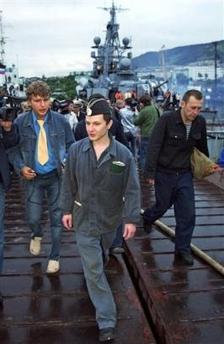
PETROPAVLOVSK-KAMCHATSKY, Russia - The seven men endured darkness and frigid temperatures for three days until their Russian mini-submarine was freed Sunday from the Pacific floor by a British remote-controlled vehicle as oxygen supplies dwindled. "It was cold, cold, very cold. I can't even describe it," one crew member with reddish hair said as the sailors walked ashore with dazed looks and bloodshot eyes after their vessel was cut loose from cables that had snagged it.

http://news.yahoo.com/fc/world/russia

Lt. Vyacheslav Milashevsky, commander of the AS-28 mini-submarine talks to press after getting off a ship at a port of Petropavlovsk-Kamchatsky Sunday morning, Aug. 7, 2005.

📎 Russian
Đăng nhập để trả lời
0
AP - Sun Aug 7, 5:47 AM ET The AS-28 mini-submarine (white and red streaks) is seen on the surface of the Pacific Ocean Sunday morning, Aug. 7, 2005, in this image taken from television. A Russian mini-submarine that was trapped for nearly three days under the Pacific Ocean surfaced Sunday with all seven people aboard alive after a British remote-controlled vehicle cut away the undersea cables that had snarled it.
(AP Photo/NTV, Russian Independent Television)

📎 submarine
Đăng nhập để trả lời
0

Reuters - Sat Aug 6, 9:24 PM ET

The U.S. military will fly an unmanned, Navy mini-submarine to Russia on Friday to join an attempt to rescue seven Russian sailors trapped aboard a stranded military mini-submarine on the Pacific floor, Navy officials said. The Russian navy, backed by a British deep-sea rescue machine, struggled on Sunday to free a trapped mini-submarine from the Pacific depths and save its crew before their air supply ran out. Handout/Reuters (Handout/Reuters)


📎 US
Đăng nhập để trả lời
0
Technicians and soldiers unload one of two unmanned submersibles, known as Super Scorpios, from a U.S. military transport C-5, at Yelozovo airport near Petropavlovsk-Kamchatsky Saturday, in this image from television. U.S. and British planes carrying robotic undersea vehicles landed in Russia's Far East on Saturday to help rescue seven sailors trapped in a mini-submarine deep in the Pacific Ocean.
(AP Photo/NTV Russian Channel)

📎 plane
Đăng nhập để trả lời
0
Super Scorpios


📎 sub
Đăng nhập để trả lời
0
Reuters - Sat Aug 6, 4:13 AM ET

A U.S. Air Force C-5 Galaxy is loaded with personnel and machinery from the Deep Submergence Unit, Naval Base Coronado in San Diego, California August 5, 2005. Two little unmanned U.S. Navy submarines were being loaded aboard a cargo plane in California on Friday to join an attempt to rescue seven Russian sailors trapped in a military mini-submarine on the Pacific floor. The remote-controlled, deep-diving 'Super Scorpio' submersibles were to depart San Diego for Petropavolvsk on an Air Force C-5 later on Friday with a team of Navy operators, said Lt. Junior Grade Maria Miller, a Navy spokeswoman at the Pentagon.
Photo by Geoffrey Patrick/Reuters


📎 Recue
Đăng nhập để trả lời
0
AP - Fri Aug 5, 7:45 AM ET

Japan's Maritime Self-Defense Force's submarine rescue mother ship Chiyoda is shown in this undated file photo provided by the Maritime Self-Defense Force. Japan's Kyodo News agency said Friday August 5, 2005 that the Japanese Defense Agency has decided to send four ships, including the Chiyoda, in rescue of a troubled Russian mini-submarine. A Russian mini-submarine with seven sailors aboard got caught on a fishing net and was stuck on the sea floor off Russia's Pacific Coast, navy officials said Friday. Navy authorities were racing to try to figure out how to raise the vessel from a depth of some 190 meters (625 feet), and a navy spokesman said the air supply on the craft was only enough to last one more day.
(AP Photo/Japan Maritime Self-Defense Force, HO)


📎 Japan
Đăng nhập để trả lời
0
U.S. Navy divers, no names given, who accompanied the British Royal Navy rescue team during an operation that saved the lives of seven Russian sailors trapped in a mini-submarine, stand next to a British remote-controlled rescue vehicle board a Russian navy ship after returning to the port of Petropavlovsk-Kamchatsky early Monday, Aug. 8, 2005.

A British Royal Navy team operated an underwater remote-controlled vehicle that cut a fishing net that trapped a Russian navy's mini-submarine underwater off Kamchatka for four days, saving all seven crew members aboard. The United States had also sent remote-controlled underwater vehicles for the rescue, but they arrived several hours after the British vehicle and were not used.
(AP Photo/Ivan Sekretarev)

📎 USBritish
Đăng nhập để trả lời
0
Royal Navy Commander Ian Riches gestures answering a question next to a Russian navy ship in the port of Petropavlovsk-Kamchatsky early Monday, Aug. 8, 2005 (local time) with the Scorpio underwater robotic vehicle sitting on its deck, left. The British team operated an underwater remote-controlled vehicle that cut a fish net that trapped a Russian navy's mini-submarine off Kamchatka for four days, saving all seven crew members aboard.
(AP Photo/Ivan Sekretarev)
Đăng nhập để trả lời
0
Royal Navy Commander Ian Riches


📎 Royal
Đăng nhập để trả lời
0
Canadian Press -
Sun Aug 7,11:08 AM ET

Lt. Vyacheslav Milashevsky, commander of the AS-28 mini-submarine stands at the port of Petropavlovsk-Kamchatsky, Russia Sunday morning. (AP Photo/Ivan Sekretarev)

📎 Vyacheslav
Đăng nhập để trả lời
0
Reuters - Sun Aug 7,10:10 AM ET

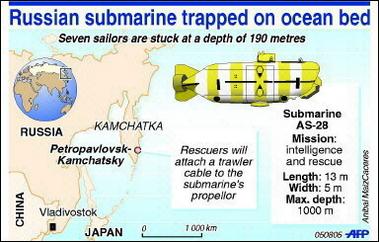
The Russian military raced against time on Friday to rescue seven sailors trapped on a stranded mini-submarine 190 meters (623 feet) down in Russia's Pacific waters with enough air to last less than 24 hours. The AS-28 mini-submarine, itself a rescue vessel, ran into trouble on Thursday when its propeller got entangled in fishing nets during a military exercise off the Kamchatka peninsula. (Reuters Graphic)

📎 russia
Đăng nhập để trả lời
0
AS-28
Đăng nhập để trả lời
0
The Super Scorpio


📎 super_scorpio_250398
Đăng nhập để trả lời
0
Reuters - Mon Aug 8, 7:52 AM ET

A British Scorpio underwater robot is lifted during a rescue operation in the Pacific Ocean, August 7, 2005 in this file handout picture. Rescuers cut a Russian mini-submarine free of tangled deep-sea cables on Sunday, saving its seven crew with British help, after a three-day ordeal deep in the Pacific with dwindling oxygen.
Picture taken August 7, 2005. REUTERS/Handout/British Ministry of Defence/Jonathan Holloway

📎 r2994002527
Đăng nhập để trả lời
0
«« « 1 2 3 4 5 » »»